

At Northeastern University in Boston, the 316 stainless steel facade of the EXP Building commands attention-and it's not just about aesthetics.

Northeastern University commissioned Boston-based Pei Cobb Freed & Partners to design and construct an expressive building that would form part of the university's new modern, flexible research spaces. Given that the project site was formerly industrial brownfield land, the project also had to further enhance the area's increasingly vibrant urban landscape.
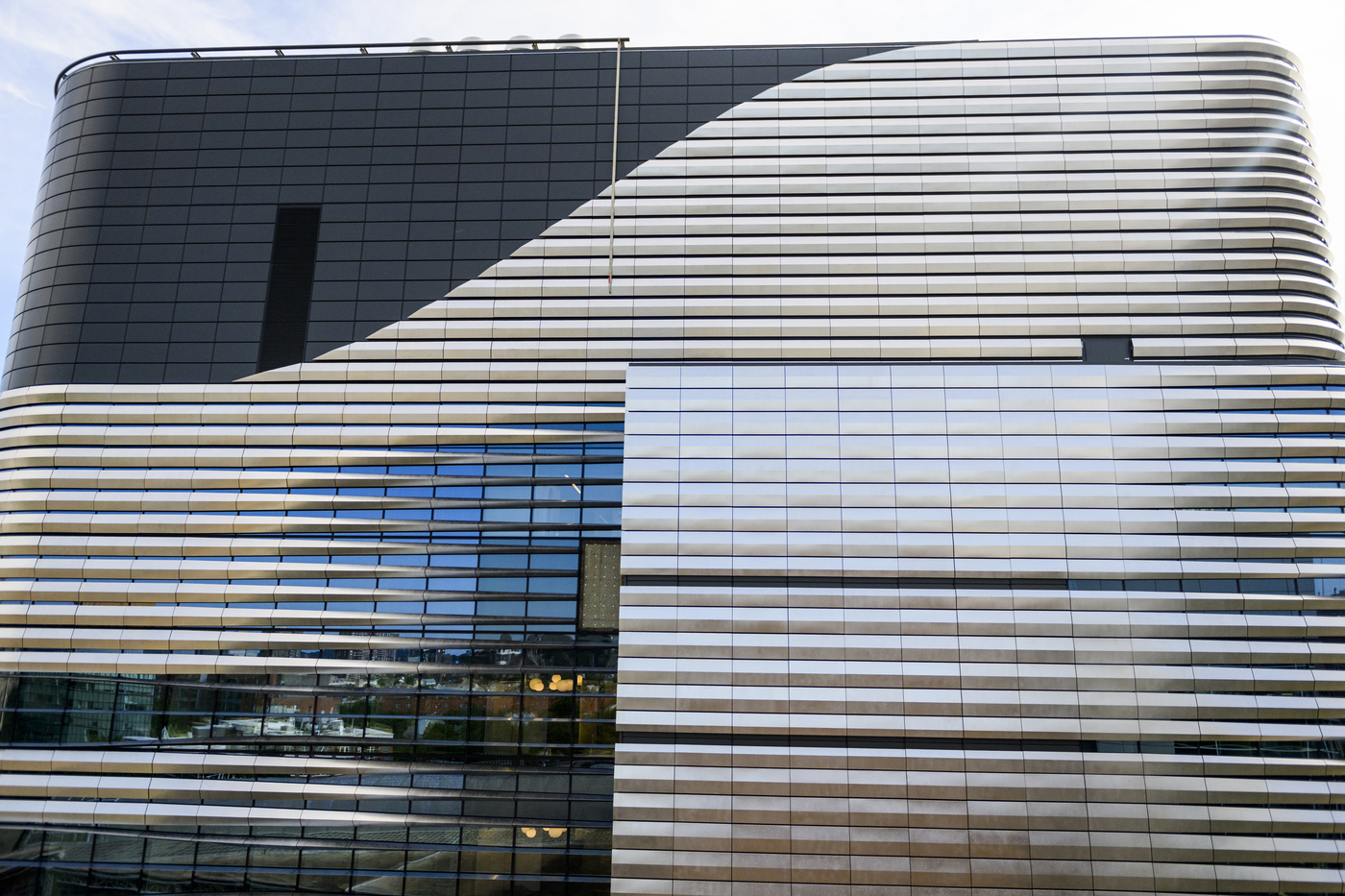
The result is the striking EXP Building. Completed in 2023, the Pei team's design aims to provide a platform for connection and collaboration among diverse innovators, functioning exceptionally well from the inside out. The building features an organic spiral design, incorporating both research and classroom zones, each defined by shared community spaces radiating from the core outward.
Stainless Steel Facade Forms a Solar Shade
The eight-story, 357,000-square-foot building is topped with a public roof garden offering sweeping views of downtown Boston. The EXP Building is not only an excellent vantage point for viewing the Boston skyline; its exterior is equally impressive. Its curved facade is clad in rows of horizontally tapered 316 stainless steel bands (low-carbon grade with molybdenum for enhanced marine atmospheric corrosion resistance), which significantly reflect light and color. These steel bands also provide solar shading and cooling for the building's interior, forming what's known as a "solar veil," thereby substantially reducing building energy consumption. Reportedly, compared to aluminum materials, the use of stainless steel reduced carbon emissions by nearly one million tons.
> Material Selection Note: Boston's coastal location means high salt content in the air. The project specified 316/316L stainless steel (ASTM A240) rather than 304, precisely for the superior pitting corrosion resistance provided by its molybdenum content (2-3%)-a common selection logic for stainless steel facades in coastal/industrial atmospheric environments.
Why Stainless Steel Suits Building Facades?
Stainless steel (such as 304/316L/2205) offers high load-bearing capacity, and its strength-to-weight ratio enables its use in long-span structures. It can also be easily formed into various distinctive shapes, adding to a building's appeal, making it particularly suitable for building exteriors. Additionally, if a stainless steel building reaches the end of its service life and requires demolition in the future, the stainless steel components can be easily recycled and reused, aligning with sustainable construction principles.
> Extended Applications: Beyond architectural facades, stainless steel sheets/coils are also widely used in chemical equipment, food processing, medical devices, and other fields. If your project requires custom cutting, surface brushing/mirror finishing, or corrosion resistance upgrades, we can provide one-stop support from material selection to Processing delivery.
Need stainless/carbon/alloy steel for architectural or industrial projects?
> Jiangsu Cunrui supplies stainless steel (304/316L/310S/2205/904L), carbon steel (Q235/Q345/45#), and alloy steel (50CrVA/30Mn2) with mill certification, custom cutting, and surface finishing services.