

Steel Engineering Redefining Architectural Possibilities
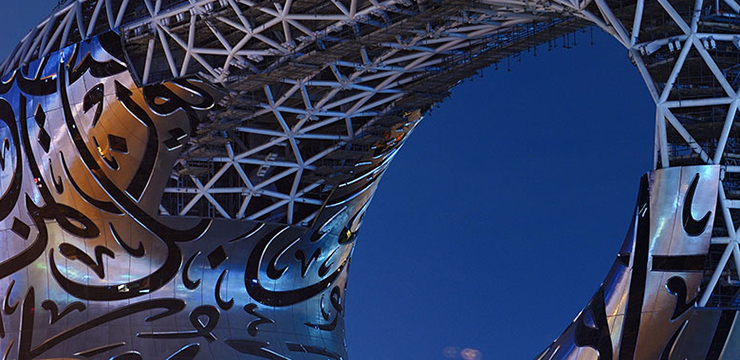
As one of the most challenging and visually striking architectural projects in the world, Dubai's Museum of the Future stands as a bold experiment in form, structure, and material innovation. Its iconic elliptical shape is not only a triumph of design but also a testament to the critical role of advanced steel materials in modern landmark construction.
From stainless steel façade systems to high-strength structural steel frameworks, steel lies at the heart of this futuristic masterpiece.
An Architectural Vision Made Possible by Steel
The museum's distinctive torus-shaped form, wrapped in flowing Arabic calligraphy, was designed by architect Shaun Killa of Killa Design, winners of the international design competition in 2015. Translating this ambitious vision into reality required materials capable of balancing strength, flexibility, precision, and durability-qualities inherent in structural steel, alloy steel, and stainless steel.
Rising 78 meters above ground, the Museum of the Future houses column-free exhibition spaces, administrative floors, and public facilities. Achieving such open interior layouts would not have been possible without the use of engineered steel structures capable of spanning large distances while maintaining structural integrity.

Engineering Innovation with Advanced Steel Structures
UK-based BuroHappold Engineering was appointed to bring the concept to life. The engineering team faced the challenge of constructing a 30,000 m² building clad largely in stainless steel, while also meeting sustainability goals such as LEED Platinum certification.
At the core of the building is a diagrid steel framework composed of approximately 2,400 intersecting steel beams, designed using parametric modeling and Building Information Modeling (BIM). By leveraging advanced digital tools, engineers optimized the steel geometry, enabling all steel tubes to share a uniform diameter-dramatically improving fabrication efficiency and installation speed.
This approach highlights the advantages of special steel and alloy steel components in complex architectural applications, where precision and consistency are paramount.

Lightweight Steel Solutions for Structural Efficiency
To reduce overall building weight and foundation loads, modular composite steel floor decking systems were employed. These steel-based solutions provided high load-bearing capacity while allowing rapid on-site assembly, demonstrating how carbon steel and composite steel products continue to support efficient construction methods.
Once the reinforced concrete support elements were completed, the entire steel superstructure was erected in just 14 months, underscoring the time-saving benefits of prefabricated and modular steel systems.
Poetry in Stainless Steel
The museum's exterior façade consists of 890 stainless-steel-clad panels, formed from glass-fiber-reinforced plastic (GFRP) and supported by the steel diagrid. These panels feature laser-cut Arabic calligraphy-verses written by Sheikh Mohammed Bin Rashid Al Maktoum-which also function as windows, illuminated by more than 14 kilometers of integrated LED lighting.
Here, stainless steel's corrosion resistance, formability, and aesthetic finish play a vital role, ensuring long-term durability under Dubai's harsh climate while preserving the building's iconic appearance.
Steel as the Foundation of Future Architecture
Positioned above Dubai's driverless metro system and adjacent to Sheikh Zayed Road, the Museum of the Future represents a radical departure from traditional skyscraper design. Its success reinforces a clear industry message: for complex, unconventional, and high-performance architecture, steel structures remain the optimal solution.
As a professional supplier of stainless steel, carbon steel, alloy steel, and special steel products, Jiangsu Curui Metal Group Co., LTD continues to support global infrastructure, architectural, and industrial projects with reliable steel materials engineered for demanding applications.
From iconic cultural landmarks to large-scale industrial facilities, steel remains the backbone of innovation-shaping not only the skylines of today, but the future of design itself.